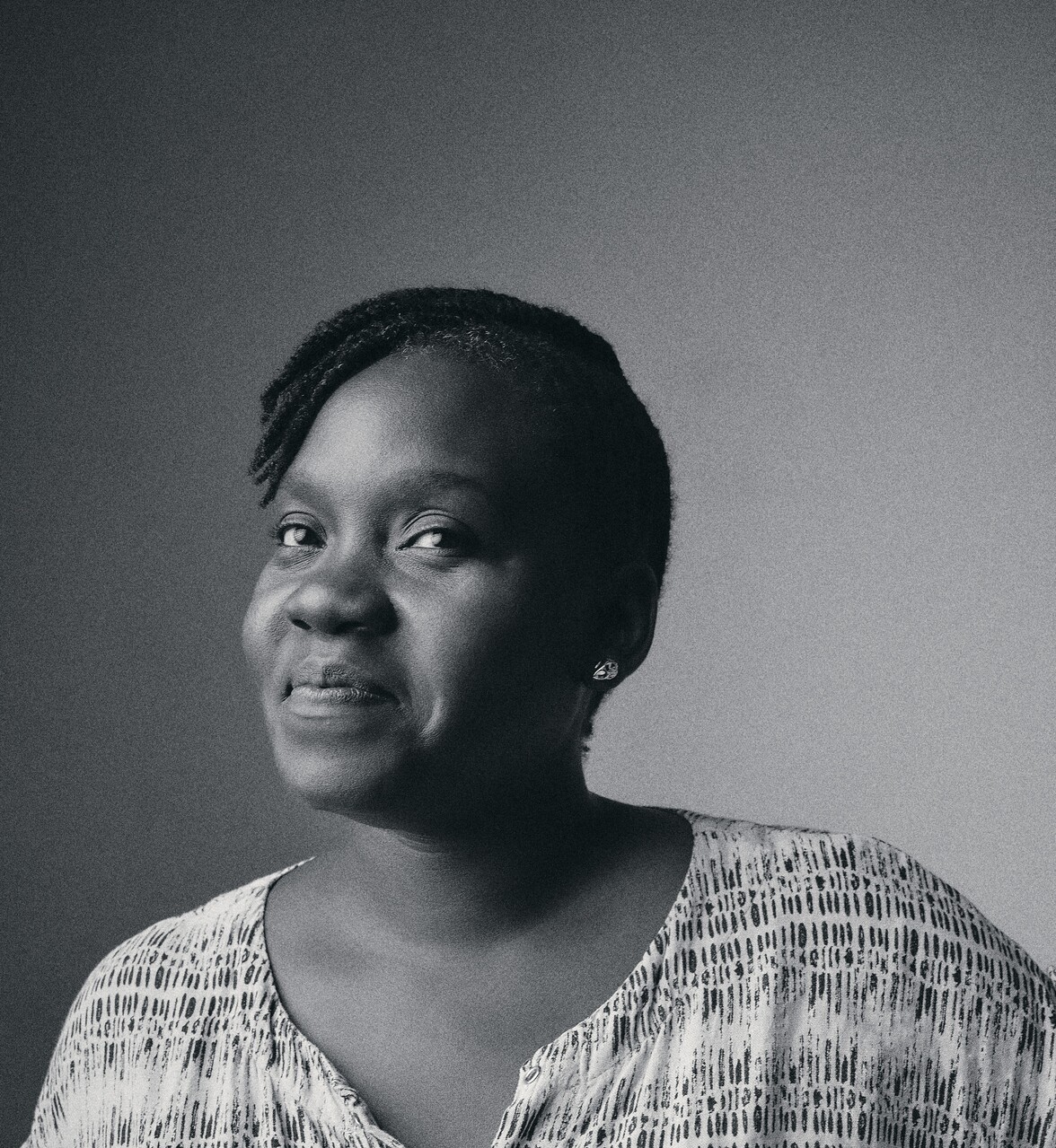
About the Artist
Sheila Nakitende is a multi-disciplinary artist and researcher based in Kampala, Uganda. She graduated with a Bachelor’s Degree in Industrial Fine Art and Design from Makerere University in 2005.
Her artistic experience ranges from concept development, product and graphics design to gallery curatorial practice, coordinating arts projects, participating in local and international art workshops, residencies and exhibitions.
Having experimented with painting before exploring installation, performance and sculpture, Nakitende’s current practice focuses on womanhood, especially on experiences that include nurturing, material culture and methodological history while addressing current influences, challenges and transformations. She works with indigenous knowledge through engaging techniques such as weaving, stitching, burning and hand papermaking.
A Prince Claus Fund Cycle 4 CAREC Fellows Awardee in 2025 and recipient of the Parent residency grant at Women’s Studio Workshop in New York, USA 2017, Nakitende participated in the Kampala Art Biennale and Kampala Art Auction in 2016.
Her solo exhibitions include “ABAANA Ba KINTU” at Chemistry Laboratory Makerere University Kampala, Uganda in 2022, “TROPIKA” at Women’s Studio Workshop New York in 2017 and “40 TWISTS” at @rtpunch Studio Kampala, Uganda in 2013.
In 2022, her work was exhibited in “Magical Hackerism or Elasticity of Resilience” at Savvy Contemporary Berlin, “Those Beings Be Not Being” exhibition at alpha nova & galerie futura Berlin, and “The Forest and Desert School Revisited” at Circle Art Gallery, Nairobi Kenya.
Nakitende participated in a duo exhibition “She That Spreads the Winds” at Gallery Brulhart Geneva Switzerland in 2023 and presented at AKAA Fair 2023 in Paris France. Her work was exhibited in “BARK RHYTHMS, Contemporary Innovations & Ancestral Traditions” at the Robert. C. Williams Museum of Papermaking Atlanta, USA in 2024.
Nakitende’s artwork is included in private and public collections such as the Buganda Kingdom Museum collection in Uganda, National Gallery of Zimbabwe and Feminist Foundation for African Contemporary Art Geneva in Switzerland.
About the Fellowship
The fellowship with artist and researcher Sheila Nakitende is hosted by the RCMC in collaboration with the Sustaining the Otherwise project. This multi-locational and multi-year research and artistic project, initiated by curators and researchers Selene Wendt and Amal Alhaag, takes an active approach to engaging with the topic of restitution by attempting to dismantle the hierarchical institutional status quo and focusing on artistic, design, research, and spatial practices that activate decoloniality in different sites and multiple temporalities.
Sheila Nakitende's fellowship builds on the working sessions held in Kampala, where the project hosted "Working with Barkcloth Histories". This workshop focused on process-based materials and explored how artistic, design and activist practices engage with and document the use of traditional materials such as raffia, banana fiber and handmade bark cloth. These conversations centralized the question of what ways the deconstruction and reconstruction of materials relate to the relationship between humans, their environment and memory work.
As a follow-up to this workshop, the Research Center for Material Culture will host Sheila Nakitende at the Wereldmuseum. During this residency, she will engage with the museum’s collection of bark cloth, opening up a space to think through how this material has been collected, archived and interpreted, and what this might mean for its future. This offers an important opportunity to reflect on how bark cloth can be understood not only as a historical object, but as a living material with ongoing cultural, ecological and artistic relevance. Looking into how bark cloth has been collected, archived, and interpreted in the past, she is pursuing a reflection on its material, historical, artistic, cultural, and ecological meanings as well as its possibilities for the future.
The residency is a direct outcome of The Earth as a Wayfinder research forum which was cohosted with collaborating partner Afropocene StudioLab in Kampala, and functioned as an initial site of study and exchange. It is through this process that a series of artistic, research and process-based trajectories were seeded, now taking shape within the broader pluriversal framework of Practicing Otherwise, which is the final chapter of Sustaining the Otherwise and actively attempts to unpack and (un)learn how restitution, material culture, dispossession and climate justice are interlinked and can be expanded beyond the object by focusing on the lifeworlds that connect us to practices that are centered around ancestral knowledge and collective creation.